Finish the squid lab/diagrams (blue page) if you haven’t already. Continue with crossword reviews. There will be a quiz next week (Thursday) on Annelida, Arthropods, and Mollusca.
Category: Biology 11
Biology 11 2-3 10 Apr 2017
Finish the Squid lab and read all accompanying notes. Complete the two crossword puzzle reviews included. Remove the last page (mollusk notes) and keep for your reference. Attach the blue squid diagram and notes page to your lab.
Biology 11 2-3 6 Apr 2017
Prepare for squid lab by researching Loligo vulgaris (common squid) to find out about its classification, body plan/structure, respiration, excretion, circulation, reproduction, digestion/feeding, mobility/appendages, nervous system, and ecological importance.
Squid external anatomy diagram labels can be found here:
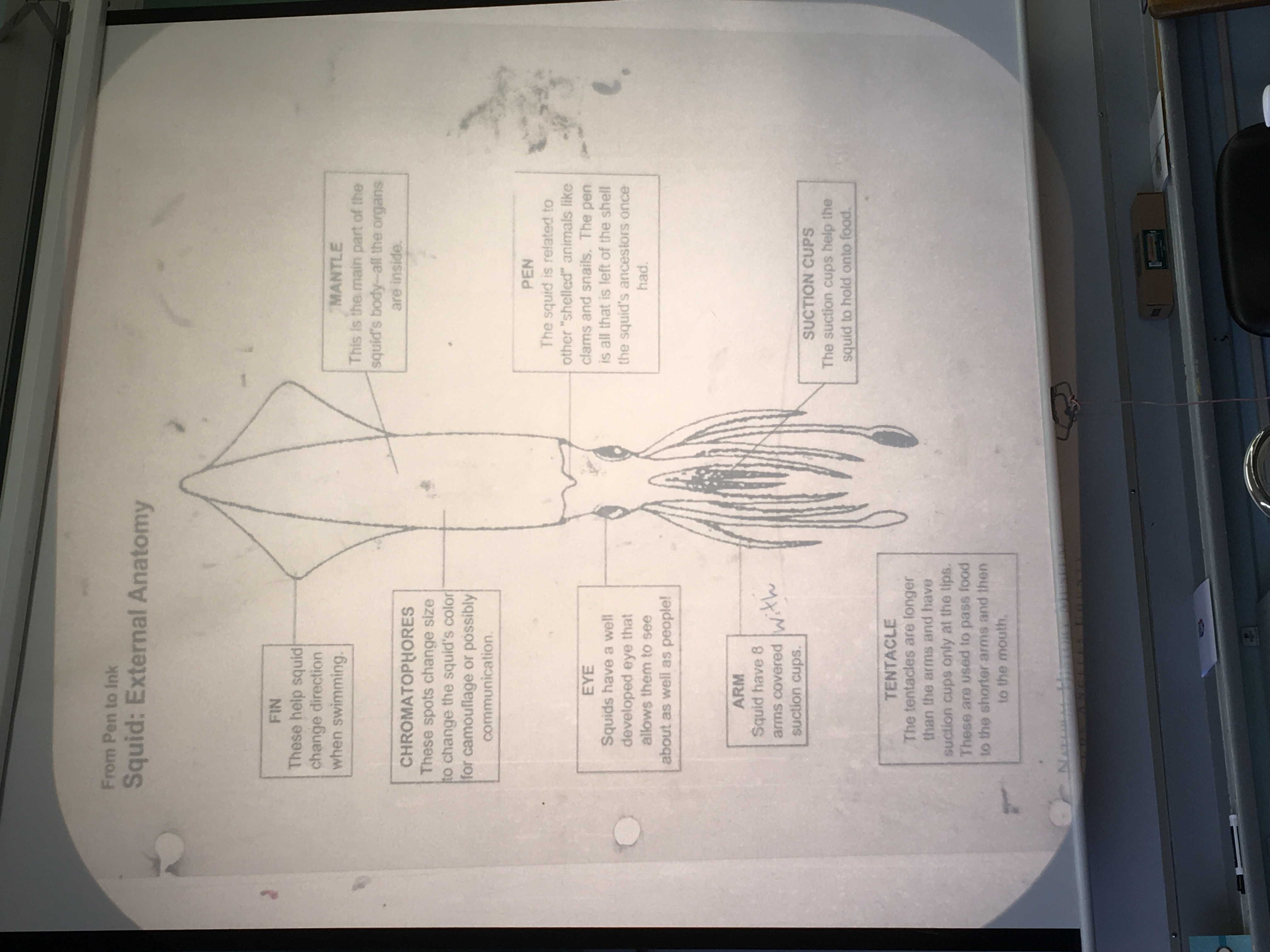
(Thank you, Manpreet!)
Biology 11 2-3, 1-1 and 1-3, 31 March 2017 and 3 April 2017
Complete all parts of the clam lab, and staple together parts 1 (external anatomy) and 2 (internal anatomy). Include the balanced chemical equation for the acid test that you performed (hydrochloric acid drop on the scraped clam shell to test for the presence of calcium carbonate). Due next class.
Continue working on the mollusk review package, and research the squid anatomy in preparation for the next dissection.
Biology 11 2-3, 1-1 and 1-3, 27, 28, 29 March 2017
Review clam anatomy and make notes/diagrams for your reference (not for handing in) in preparation for clam dissection.
Please ensure you have researched Phylum Mollusca and taken notes on their classification, body plan, respiration, excretion, reproduction, digestion, motility, nervous system, circulation (internal transport) and ecological importance. Block 2-3 Molluska Jigsaw (note) can be accessed here.
Work on mollusk handout and bring all clam/mollusk paper to class.
Biology 11 10 March 2017
Continue researching segmentation, coelomates (main points) and look up synapomorphy and plesiomorphy. Watch the Crash Course video on Complex Animals (Youtube).
Biology 11 3 March 2017
Finish the earthworm lab and be sure the pink diagram (external anatomy) includes the following labels:
- anterior, posterior, ventral, dorsal surfaces
- segments, clitellum
- mouth, anus
- bristles (or setae)
- any reproductive openings you observed
Bio 11
Research Annelida and segmentation in animals. We will be doing the earthworm lab next class.
Biology 11 27 and 28 Feb 2017
Read text section on Phylum Annelida and make note of their main characteristics and structures.
Biology 11 22 Feb 2017
Compound eye: Using the Animals Without Backbones text (in class only) and other resources (eg. on the web), research the compound eye.
- Sketch and label the parts of the compound eye.
- In point form, explain (a) how the compound eye functions; (b) the structure of the compound eye (ommatidia: lens, cone, visual cell, pigment cell); (c) arrangement of the ommatidia; (d) image formed (how the image appears to the insect); (e) colour vision; (f) ultraviolet vision.
- Record all the sources used.