Work on the problems handed out in class, attempting as many as you can. We will go over them in class together. Read section 9.1 (acceleration).
Science 9 2-1 and 2-1 6 Apr 2017
Complete all flash cards using the 43 terms on the review sheet given in class for unit 3. Bring completed flash cards to class next time.
Complete the concept map for next class.
Biology 11 2-3 6 Apr 2017
Prepare for squid lab by researching Loligo vulgaris (common squid) to find out about its classification, body plan/structure, respiration, excretion, circulation, reproduction, digestion/feeding, mobility/appendages, nervous system, and ecological importance.
Squid external anatomy diagram labels can be found here:
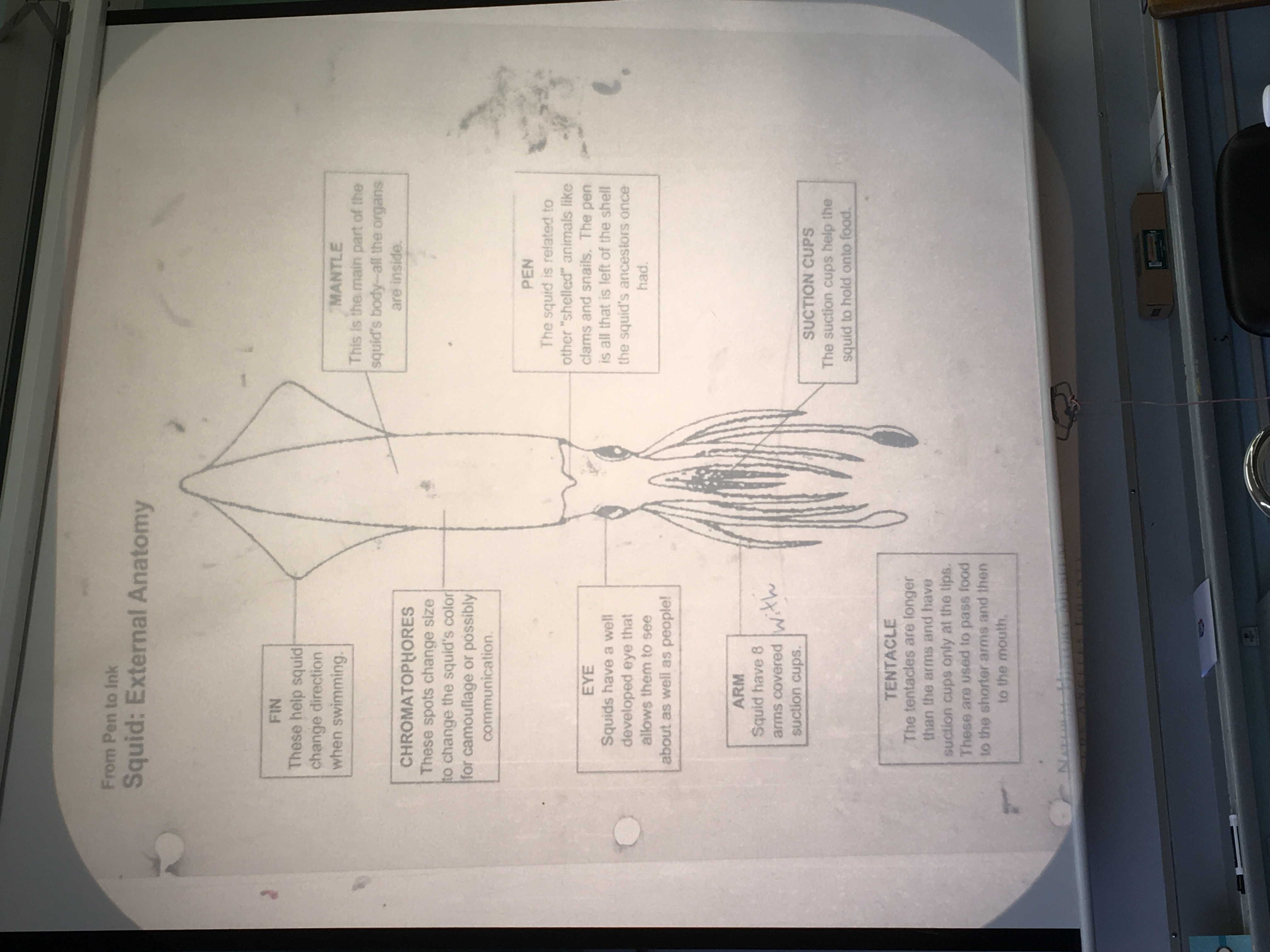
(Thank you, Manpreet!)
Mini Science 10 6 Apr 2017
Complete Activity 8-2C in the textbook.
Please bring graph paper to class.
Mini Science 10 4 Apr 2017
Calculate average speed (distance / time) for graph H between t=0s and t=10s.
Complete activity 8-2B in the textbook.
Biology 11 2-3, 1-1 and 1-3, 31 March 2017 and 3 April 2017
Complete all parts of the clam lab, and staple together parts 1 (external anatomy) and 2 (internal anatomy). Include the balanced chemical equation for the acid test that you performed (hydrochloric acid drop on the scraped clam shell to test for the presence of calcium carbonate). Due next class.
Continue working on the mollusk review package, and research the squid anatomy in preparation for the next dissection.
Mini Science 10 31 March 2017
Velocity V. Time graph: Sketch the velocity versus time graph representing a single jump on a trampoline, starting at the moment the person’s feet leave the trampoline and ending at the moment their feet touch the trampoline again. You do not need to number the axes, but do be sure that you label them properly and that you give the graph a suitable title. Be sure to use a ruler to draw the axes.
Be sure you have finished the graph of Activity 8-1C and the two questions.
Complete the Activity 8-1D in the textbook, and answer the included questions.
Mini Science 10 29 Mar 2017
Read section 8.2 in the text. Complete the activity 8-1B on p. 352. Due next class.
Science 9 blocks 1-4, 2-1, and 2-2, 29 and 30 March 2017
Be sure to finish 9.2 in the workbook, if you haven’t already (assigned before Spring break).
Do activity 9-2B on p. 326 (chart and 2 questions, only) for homework. Due Friday (2-1 and 2-2) and Monday (1-4).
Science 9 1-4, 2-1 and 2-2 27 and 28 March 2017
Finish the power and energy questions given in class (from BC Science). Be sure to follow the steps we used in class.
In case you didn’t finish in class, the last few questions are below.
4. What is the current through a 6.0 W bulb when it is connected to a 1.5 V battery?
5. (a) A 40 W bulb is connected to a power supply and draws a current of 0.75 A. What is the voltage of the power supply?
5. (b) IF the 40 W light bulb is replaced by a 100 W light bulb, how much current will flow through the 100 W bulb? (Hint: Use the voltage found in part (a))
6. What is the power, in watts, of an unknown device, if a current of 35 mA flows through the device when it is connected to 3.0 V?
7. How much energy, in joules, is consumed by a 120 W light bulb if it is left on for 15 mins?
8. How much energy, in joules, is consumed by a 1400 W hair dryer if it is used for 10 mins?
9. How much energy, in joules, is consumed by a 200 W stereo if it is left on for 4.0 h?
Be sure to bring a calculator (cell phones cannot be used as calculators), textbook and workbook.
Assigned before Spring break: Read 9.2 in text and do 9.2 in workbook.